Surveillance is the documented observation of a person or location over time. It supports infidelity cases, custody disputes, insurance and workers compensation claims, and corporate matters. In Manhattan, surveillance is a specialized skill because the environment is unlike anywhere else: vertical, crowded, and constantly moving.
This guide covers the methods professional investigators use, the legal lines under New York law, and what makes surveillance evidence admissible. We match you with NYS-licensed investigators who run these operations; we do not conduct surveillance ourselves.
How Surveillance Works in Manhattan
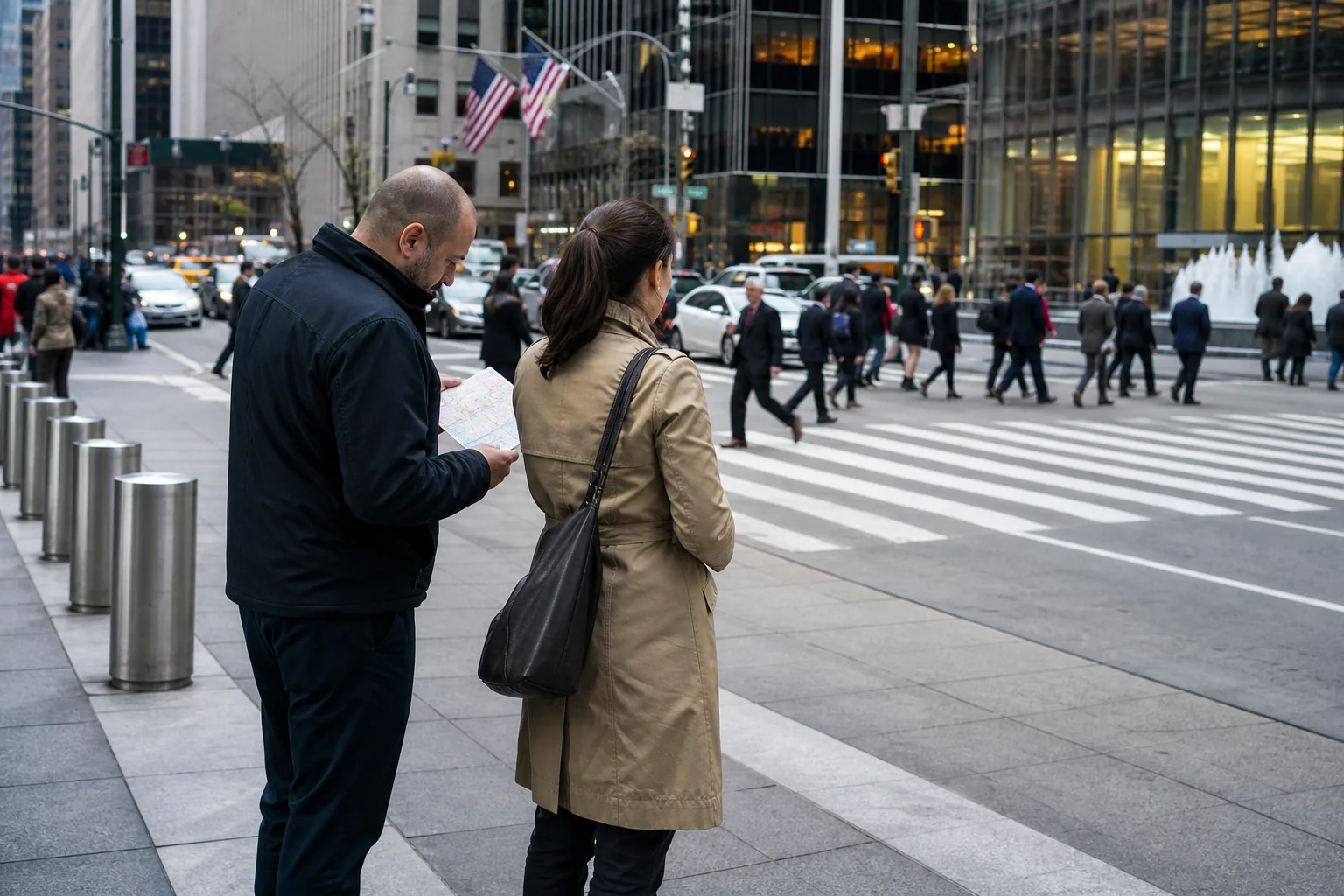
Outside dense cities, surveillance often means an investigator in a vehicle watching a driveway. Manhattan rarely works that way. Subjects move on foot, by subway, and by rideshare, and a stationary vehicle stands out. Effective Manhattan surveillance is usually a coordinated foot operation by two or more agents who rotate position so no single face is seen too often.
Investigators use cameras capable of clear capture from a distance and maintain a written log alongside the footage. The deliverable is a report with timestamped entries, photographs and video, and, where relevant, a record of locations and durations, packaged so an attorney can use it.
Covert versus overt
Most investigative surveillance is covert: the subject does not know they are being observed, which preserves natural behavior. Overt surveillance, where a visible presence is intended to deter or to prompt a reaction, is occasional and case-specific. Your investigator will recommend the approach that fits your objective.
What New York Law Allows
The governing principle is the reasonable expectation of privacy. There is no such expectation in a public place, so observing and recording someone on a sidewalk, in a park, or in a publicly accessible business is lawful. There is an expectation of privacy inside a home, a private office, or a bathroom, and recording there is not.
- •Public-space observation and photography: legal.
- •Audio recording of conversations: New York is a one-party-consent state for recording a conversation you are part of, but a third party recording others without consent can violate eavesdropping law. Investigators handle audio conservatively.
- •GPS tracking: placing a tracker on a vehicle you do not own raises real legal exposure, so investigators apply it only where lawful.
- •Trespass: never. Evidence from a trespass is both unlawful and likely inadmissible.
How Surveillance Evidence Holds Up
Surveillance evidence is admitted in New York courts routinely when three things are true: it was gathered legally, it is documented with a clear chain of custody, and the investigator who gathered it is prepared to testify to its authenticity. Footage with gaps, no logs, or an unlicensed source is far easier for opposing counsel to challenge.
This is the practical case for using a licensed investigator rather than gathering material yourself. A professional builds the record to evidentiary standards from the first hour, which is difficult to reconstruct after the fact.
Frequently Asked Questions
Is surveillance legal in New York?
Yes, in public spaces. There is no reasonable expectation of privacy on a sidewalk, in a park, or in a publicly accessible business, so observation and photography there are lawful. Recording inside a home or other private space, or trespassing to observe, is not.
Can an investigator put a GPS tracker on a car?
It depends on ownership. Placing a tracker on a vehicle you do not own or jointly own raises legal exposure under New York and federal law, so licensed investigators use tracking only where it is clearly lawful and advise against it where it is not.
How many investigators does Manhattan surveillance need?
Most Manhattan surveillance needs at least two agents so coverage continues if one is spotted. Busy commercial areas or complex movements can require three or four to maintain a seamless watch without detection.
Get a Free Manhattan Consultation
Every consultation is free and confidential. Tell us about your situation and we will match you with a licensed investigator who handles cases like yours.